Change Language :
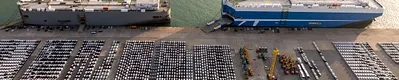
RoRo terminal
Shore power supply for RoRo terminals
Efficient Ro-Ro operations depend on short turnaround times and maximum space availability. Shore power solutions must therefore be powerful, robust, and fully compatible with terminal operations. Discover how innovative shore power systems reduce emissions while ensuring smooth terminal operation.
Key data on shore power for Ro-Ro terminals

6.5MVA

11kV

16kA/s

1 connector
Challenges for Ro-Ro terminals
The requirements of IEC 80005-1 and the safe connection between ship and shore power - the so-called "connection dilemma" - are among the central challenges of shore power projects.
IEC 80005-1 (Annex B for Ro-Ro ships)
The IEC/IEEE 80005-1 standard series defines the requirements for high-voltage shore connection (HVSC) systems and forms the basis for a safe and globally interoperable shore power infrastructure. For Ro-Ro cargo and Ro-Ro passenger ships, Annex B describes the technical interfaces between the ship and the terminal and ensures that shore power systems can be planned, tested, and operated in a standardised manner. This ensures compatibility and operational safety.
Key requirements for Ro-Ro terminals and Ro-Ro ships
- High-voltage shore power supply with 11kV AC
- In regional applications, a version with 6.6kV AC is also possible
- A high-voltage cable for power requirements up to 6.5MVA
- Seven integrated pilot contacts for monitoring and securing the connection
- Fibre optic-based data communication for control and monitoring functions
- Controlled connection and disconnection of the shore power supply via defined safety circuits
- Integrated emergency stop and locking functions for safe operation
- Cable management system on the terminal side for guiding and positioning the connection cable
- Type-tested plug connection according to IEC 62613 and IEC/IEEE 80005-1 Annex B
- Continuous monitoring of the connection via pilot and safety circuits
- Reliable energy transmission even during the dynamic operations of Ro-Ro terminals
- Standardised interface for Ro-Ro cargo and Ro-Ro passenger ships
The IEC 80005-1 standard series defines in detail
- Safe energy transmission between ship and terminal
- Integrating shore power systems into areas with high vehicle traffic, short vessel turnaround times and continuous cargo-handling operations This is also the central challenge of modern shore power projects in Ro-Ro terminals.
iMSPO options - igus Mobile Shore Power Outlet for Ro-Ro terminals


Technical information on the iMSPO for Ro-Ro terminals
Find out more about the various configurations, integration options and technical versions of the iMSPO.
- Installation on the quay edge outside traffic and cargo-handling areas
- Flexible positioning of the socket box along the entire berth
- Suitable for different connection positions of Ro-Ro and Ro-Pax ships
- Compensation of ship movements and tidal changes by transfer machine
- No impairment of loading bays, vehicle traffic, and handling processes
- Terminal areas remain completely free for lorries, trailers, and terminal vehicles
- No exposed high-voltage cables in traffic areas
- No risk of collision or damage due to crossing vehicle movements
- Energy and data transmission via a heavy-duty energy chain system
- Designed in accordance with IEC/IEEE 80005-1 Annex B and applicable safety guidelines
- Ro-Ro version according to IEC/IEEE 80005-1 Annex B with 6.6kV or 11kV and outputs up to 6.5MVA
- Maritime steel construction with duplex corrosion protection
- Maximum operational reliability with unrestricted terminal operation
- Installation of the system in a closed trench along the quay edge
- Completely concealed system guide without visible components on the terminal surface
- The iMSPO moves in a protected manner within the trench and flexibly positions the mounting point at the respective berth
- Convenient control of the system via radio remote control
- Energy and data transmission via a protected and easy-to-maintain system
- No exposed medium-voltage cables or other obstacles in the operating area
- Safe transfer of the connection cable to the Ro-Ro ship via a transfer vehicle
- Ro-Ro version according to IEC/IEEE 80005-1 Annex B with 6.6kV or 11kV and outputs of up to 6.5MVA
- Preferred installation version for new structures
- Particularly suitable for the highest demands in terms of safety, aesthetics and terminal operation
- Supplying shore power to cruise ships, container ships, Ro-Ro ships, or Ro-Pax ships via a common shore power infrastructure
- Container version according to IEC/IEEE 80005-1 Annex D with 6.6kV and outputs up to 7.5MVA
- Cruise version according to IEC/IEEE 80005-1 Annex C with 11kV and power up to 16MVA
- Ro-Ro version according to IEC/IEEE 80005-1 Annex B with 6.6kV or 11kV and outputs of up to 6.5MVA
- Automatic detection of the connected ship type and selection of the appropriate system configuration
- Mobile positioning of the connection point along the berth by the iMSPO
- Joint use of transformer, frequency conversion, and switchgear systems
- One investment for several ship types and different terminal requirements
- Reduction of infrastructure, space, and investment costs compared to separate systems
- Designed in accordance with IEC 80005-1 and the applicable safety and earthing concepts
- Future-proof solution for multi-use terminals with mixed ship traffic
- Electrically driven transfer machine based on a modified Genie Z45 DC lifting platform
- Developed for the safe transfer of shore power cables between iMSPO and ship in accordance with IEC 80005-1 and the EU Machinery Directive
- Integration of an igus triflex® cable management system for the protected guide of the high-voltage cables
- Safe and ergonomic positioning of connectors and cables directly on the ship
- Connection area up to 12m transfer height and 6.9m horizontal reach
- 355° rotation range for maximum flexibility with different ship geometries
- Global access to Genie service partners, trained technicians and available spare parts significantly reduces downtime and simplifies maintenance processes
- Easy maintenance thanks to the globally established Genie standard platform.
- Compact and lightweight design for use in confined terminal areas
- Fully electric battery operation for emission-free and quiet use in the harbour
- Protection of cables against mechanical load and damage during the connection process
- Operational at wind speeds of up to 25m/s with optional support system
- Integrated safety functions with end position monitoring, locking devices, and emergency stop system
- Special maritime corrosion protection system with additional coating for long-term use in ports
- Planned service life of up to 15 years with proper maintenance and inspection
The iMSPO in use worldwide
For years, ports and terminals around the world have relied on igus shore power supply solutions. From container and cruise terminals to applications at Ro-Ro terminals - our systems prove themselves daily under real operating conditions on all continents.
Consulting
I look forward to answering your questions

Shipping and consultation
In person:
Monday to Friday from 7 am - 17 pm.
Saturdays from 8 am- 12 pm.
Online:
24h
WhatsApp-Service:
Montag – Freitag: 8 – 16 Uhr