Change Language :
iglidur® F2 - material data
Material data table
General properties
Unit
iglidur® F2
Testing method
Density
g/cm³
1.52
Colour
black
Max. moisture absorption at +23°C/50% room humidity
% weight
0.2
DIN 53495
Max. moisture absorption
% weight
0.4
Coefficient of sliding friction, dynamic against steel
µ
0.16 to 0.22
pv value, max. (dry)
MPa x m/s
0.31
Mechanical properties
Flexural modulus
MPa
7,418
DIN 53457
Flexural strength at 20°C
MPa
93
DIN 53452
Compressive strength
MPa
61
Maximum recommended surface pressure (20°C)
MPa
47
Shore D hardness
72
DIN 53505
Physical and thermal properties
Max. long-term application temperature
°C
+120
Max. short-term application temperature
°C
+165
Min. application temperature
°C
-40
Thermal conductivity
[W/m x K]
0.61
ASTM C 177
Coefficient of thermal expansion (at 23°C)
[K-1 x 10⁻⁵]
5
DIN 53752
Electrical properties
Specific transitional resistance
Ωcm
<109
DIN IEC 93
Surface resistance
Ω
<109
DIN 53482
Table 01: Material data
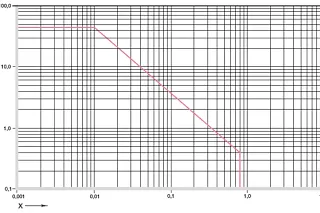
Diagram 01: Permissible pv values for iglidur® F2 plain bearings with a wall thickness of 1mm in dry operation against a steel shaft at +20°C, mounted in a steel housing
X = Surface speed [m/s]
Y = Load [MPa]
The prevention of electrostatic charge is an important requirement in many application areas. At the same time other technical application parameters such as resistance to wear, media and high temperatures, suitability for wet environments etc. must not be neglected. With its wide range of specifications, iglidur® F2 is a new universal bearing for numerous "ESD-suitable" applications.
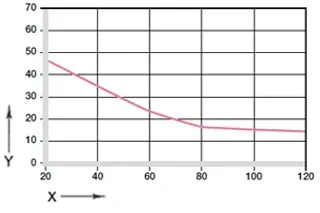
Diagram 02: Maximum recommended surface pressure as a function of temperature (47MPa at +20°C)
X = Temperature [°C]
Y = Load [MPa]
Mechanical specifications
With increasing temperatures, the compressive strength of iglidur® F2 plain bearings decreases. Diagram 02 shows this inverse relationship. With the long-term permitted application temperature of +120°C, the permitted surface pressure still amounts to 20MPa. The maximum recommended surface pressure represents a mechanical material property. No conclusions regarding the tribological properties can be drawn from it.
Diagram 03 shows the elastic deformation of iglidur® F2 under radial loads. At the maximum recommended surface pressure of 47MPa, the deformation is less than 2.6%. Up to this load, plastic deformation can be neglected. However, it also depends on the impact time.

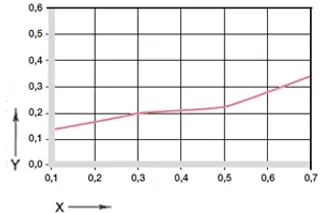
Diagram 04: Coefficient of friction as a function of the surface speed, p = 0.75MPa
X = Surface speed [m/s]
Y = Coefficient of friction μ
Friction and wear
Coefficient of friction and wear resistance vary with the application parameters (Diagrams 04 and 05).
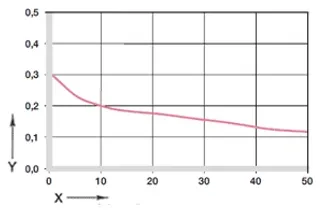
Diagram 05: Coefficient of friction as a function of the pressure, v = 0.01m/s
X = Load [MPa]
Y = Coefficient of friction µ
iglidur® F2
dry
Greases
Oil
Water
Coefficient of friction µ
0.16 to 0.22
0.1
0.05
0.03
Table 04: Coefficient of friction for iglidur®F2 against steel (Ra = 1μm, 50HRC)
Shaft materials
Diagram 06 shows the results of tests carried out with different shaft materials and plain bearings made of iglidur® F2. In the lower load range, free cutting steel and hard-anodised aluminium shafts, but also HR carbon steel and hard-chromed steel shafts prove to be the best mating partners in rotating applications with iglidur® F2 plain bearings. In the entire load range, 07 shows significantly less wear during rotations than during pivoting movements.


Consulting
I look forward to answering your questions

Shipping and consultation
In person:
Monday to Friday from 7 am - 17 pm.
Saturdays from 8 am- 12 pm.
Online:
24h
WhatsApp-Service:
Montag – Freitag: 8 – 16 Uhr