Change Language :
DC motors for industrial applications
Design, function, and advantages

Different versions of the DC motor
DC geared motors are available in different versions at igus. Thanks to high stock availability, the desired motor is usually ready to ship within 24 hours. Here you can find four different versions of the popular DC motor at a glance.
Different torques and speeds can be achieved with DC geared motors for 12 to 24 volts. Depending on the version, they reach torques of up to 3Nm and speeds between 20rpm and 1,200rpm. In combination with drylin axes, this flexibility also enables the simple implementation of linear movements. The compact, quiet motors can be connected to a power supply unit or directly to a battery via flat connectors. The direction of movement can be easily changed by reversing the poles. Alternatively, igus offers suitable motor control systems for DC motors.


DC motor structure and function

Advantages of DC motors


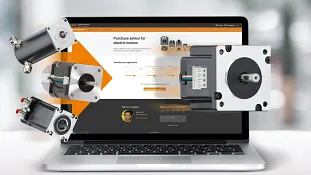
DC motor purchasing aid
The right motor in just a few clicks
The purchasing aid for electric motors displays suitable DC motors from our portfolio according to individual requirements.
- Find the right products quickly
- With suitable gearbox
- Including technical data
- Ready to ship from 24 hrs after receipt of order
Frequently asked questions about DC motors:
DC motors and AC motors are two types of electric motors that are used depending on the application and requirements.
DC motors:
A DC motor is an electrical machine that generates mechanical energy by means of a direct current source (e.g. battery or power supply unit). It is particularly suitable for applications that require precise control system, high torque at low speeds, and a compact design.
Features and benefits:
- Easy to control: DC motors are easy to control and regulate. Speed and torque can be adjusted with comparatively little effort, making them suitable for numerous industrial and mobile applications.
- High starting torque: DC motors provide a high torque as soon as they start. This makes them particularly suitable for applications with high starting forces, such as conveyor systems, lifting devices, or electric adjustment units
- Compact design: Thanks to their compact type, DC motors are particularly suitable for applications with limited installation space, for example in mobile devices, adjustment units, or medical systems.
Application areas:
- Electric adjustment units and actuators
- Conveyor technology and material handling
- Medical devices and laboratory equipment
- Mechanical engineering and industrial handling
- Lifting and positioning systems
- Pumps, valve and flap actuators
- Mobile battery-operated devices
- Electric tools and small actuators
AC motors:
An AC motor is powered by energy from an alternating current source and is designed for use in industrial machines, high-performance applications, and wherever durability and energy efficiency are required.
Features and benefits:
- Efficiency with high loads: AC motors are extremely efficient, especially in applications with constant power requirements.
- Robustness and durability: AC motors have a solid construction and very few components that are susceptible to wear, which leads to a longer service life.
- Performance: AC motors are designed for high power and can handle high loads without any problems.
- Flexibility through frequency converters: Modern AC motors can be extended with frequency converters for precise control.
Application areas:
- Industrial machinery and pumps
- Heating, ventilation and air conditioning (HVAC)
- Lifts and conveyor systems
- Large systems such as cranes and compressors
Commutation is a process in which the current flow in an electrical system is specifically switched to ensure a specific function permanently, such as maintaining a uniform torque in a motor or producing rectified current in a generator.
In mechanical commutation, brushes and a commutator take over the task of regularly changing the direction of the current in the rotor. This ensures that the motor rotates smoothly or the generator produces constant direct current.
In electronic commutation, on the other hand, sensors and electronic switching elements, such as transistors, take over the switching of the current. This process is mainly used in modern brushless motors and electronic devices because it is more efficient and durable.
In summary, commutation ensures that electrical machines can operate reliably and optimally.
Torque is the rotating force that the motor produces. The drylin E DC motors are available in various versions for different torques:
- Up to 1.8Nm for motors with spur gear.
- Up to 1.8Nm for motors with planetary gearbox.
- Up to 3.0Nm for motors with worm gear.
The speed describes the speed of the shaft in revolutions per minute (rpm). Depending on the motor, speeds from 22rpm to 1200rpm can be achieved. In combination with drylin linear axes, linear motion speeds of up to 300mm/s can be achieved.
The efficiency level describes how effectively electrical energy is converted into mechanical energy. Thanks to their optimised design, the drylin motors can achieve a high efficiency of up to 96%. This is achieved through high-quality gearboxes and reduced friction loss.
- Heat loss: Heat is generated by resistance in the rotor windings.
- Friction loss: Carbon brushes and bearings cause mechanical friction.
- Magnetic losses: Incomplete magnetisation and eddy current losses can occur.
- Gearbox losses: Partial power transmission losses occur in the mechanical gearbox.
igus reduces these losses by using wear-resistant materials and precise manufacturing techniques.
More information on the DC motor


Consulting
I look forward to answering your questions
Shipping and consultation
In person:
Monday to Friday from 7 am - 17 pm.
Saturdays from 8 am- 12 pm.
Online:
24h
WhatsApp-Service:
Montag – Freitag: 8 – 16 Uhr